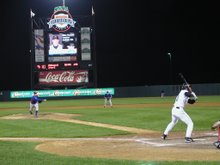
Yes, the New York Yankees finally looked like the New York Yankees last night at home in their 8-4 win in Game 3 of the ALDS. Or I should say, they looked like the Yankees in the second half of last night's game, because going into the bottom of the 5th, they were down 3-1 and had grounded into 3 double plays. A Johnny Damon 3-run blast and 3 2/3 innings of solid relief pitching from Phil Hughes later, they had the game well in hand. But they're not out of the woods, yet.
Now Joe Torre, whose job is officially on the line, is going with Chien Ming-Wang on 3 days rest (rather than Mike Mussina) in hopes of forcing Game 5 back in Cleveland. The Tribe will counter with Paul Byrd (rather than C.C. Sabathia on 3 days rest).
Let's not forget, Wang was roughed up in Game 1, although some have speculated it was because he had "too much rest" and so his sinker wasn't sinking the was it usually does. Either way, they need him to come up big tonight because if he if unable to go at least 7 innings, New York could be in a very precarious situation.
Phil Hughes clearly won't be available. Joba Chamberlain threw 38 pitches last night over 2 innings, so he might not be available. Torre not starting Mussina sends a clear message about the team's confidence level in him, so why would you want him relieving? That really only leaves Luis Vizciano (who took the loss in Game 2), Ross Ohlendorf (who's retired 22 big league hitters in his career, and was lit up in Game 1), Jose Veras (who has less than 21 career innings under his belt) and Kyle Farnsworth (who's thrown 8 innings since August 29 and none in the ALDS). Plus, Mariano Rivera did throw an inning last night (albeit just 10 pitches), so the odds of him throwing the 7th, 8th, and 9th seem unlikely.
 On a sort-of related note, I wouldn't be surprised if we saw Roger Clemens throw his last big league pitch last night and I'm definitely not alone. His hamstring is clearly bothering him. Rest clearly didn't help. So starting him again makes little sense, and getting him hot quickly to relieve makes even less. With all due respect to Clemens, who is without question one of the greatest pitchers in the history of baseball, his 2007 signing with New York has to rank among the worst moves in pro sports history. $28 million dollars pro-rated for 18-starts, a 6-6 record, 4.18 ERA, and 99 IP in the regular season, plus 7 hitters retired in the postseason is not much of a return on the Boss' investment.
So at 7:37 tonight, we'll see what Wang is made of in Game 4. If the answer is "not much" there probably won't be a Game 5.
 What does it take to be #1? Or, better put, what does it take to be a #1 starter in Major League Baseball?
I was having this discussion recently with a friend of mine who's a big Yankee fan. And the specific topic of the discussion was Chien-Ming Wang.
My position was that Wang is not a #1, despite his 2006 season. And, not surprisingly, the guy on the other end of the conversation thought I was nuts.
First, my logic. Wang was great in 2006. He won 19 games. He finished (a distant) second in Cy Young voting. And he finished tied for 7th in the league in ERA (3.63).
 Now let's dig deeper. With his spectacular numbers, he carried a rather ordinary 1.31 WHIP, good for 18th in the league, and an even less impressive 76 strikeouts (tied for 37th best in the league). There are a handful of closers who had more K's last year, and they did it in about a third of the innings.
So Wang's a contact pitcher, so what? Does that mean he's not good? Well, consider this. This is a list, by season, of the pitcher who had the most wins that year without reaching 100 strikeouts.
2006 - Chien-Ming Wang (19W, 76K)
2005 - Kenny Rogers (14W, 87K)
2004 - Ismael Valdes (14W, 67K)
2003 - Ramon Ortiz (16W, 94K)
2002 - Kirk Reuter (14W, 76K)
2001 - Kirk Reuter (14W, 83K)
2000 - John Halama (14W, 87K)
1999 - Omar Olivares (15W, 85K)
1998 - Brian Anderson (12W, 95K)
1997 - Willie Blair (16W, 90K)
1996 - Jamie Moyer (13W, 79K)
1995 - Mark Gubicza (12W, 81K)
1994 - Jimmy Key (17W, 97K)*
1993 - Bob Tewksbury (17W, 97K)
1992 - Bob Tewksbury (16W, 91K)
1991 - Bill Gullickson (20W, 91K)
1990 - Tom Browning (15W, 99K)
*Key only made 25 starts because of the strike.
The names on this list don't exactly scream "aces" to me. And I was amazed to see Bill Gullickson won 20 without 100 punch-outs in 1991.
So if Wang is putting guys on base, and not striking many out, how was he so successful last year? The answer is double-play-balls. He got 33 of them in 2006, second only to Jake Westbrook's 36. It's hard to imagine someone who relies that much on his defense is going to be consistently good for a multi-year stretch (i.e., a #1 starter ).
Want more proof that Wang just had a good year, but isn't a #1? In 34 starts, only 18 of them were considered quality starts (at least 6 innings pitched, no more than 3 earned runs). Yet, he won 19 games. Only a few other pitchers (with at least 10 quality starts) pulled off that feat last year. John Garland did it (18W, 17QS), so did Jason Marquis (14W, 13 QS). And you know who else did it? Randy Johnson. The Big Unit had 17 wins, with only 14 quality starts. You know what Wang and Johnson have in common? The Yankee lineup. Johnson was #1 in baseball last year in run support. Mike Mussina was #5 and Wang was #12.
In short, is Wang a good picther? Yes. Is he a #1 starter? No way.
 Yes, the New York Yankees finally looked like the New York Yankees last night at home in their 8-4 win in Game 3 of the ALDS. Or I should say, they looked like the Yankees in the second half of last night's game, because going into the bottom of the 5th, they were down 3-1 and had grounded into 3 double plays. A Johnny Damon 3-run blast and 3 2/3 innings of solid relief pitching from Phil Hughes later, they had the game well in hand. But they're not out of the woods, yet.
 On a sort-of related note, I wouldn't be surprised if we saw Roger Clemens throw his last big league pitch last night and I'm definitely not alone. His hamstring is clearly bothering him. Rest clearly didn't help. So starting him again makes little sense, and getting him hot quickly to relieve makes even less. With all due respect to Clemens, who is without question one of the greatest pitchers in the history of baseball, his 2007 signing with New York has to rank among the worst moves in pro sports history. $28 million dollars pro-rated for 18-starts, a 6-6 record, 4.18 ERA, and 99 IP in the regular season, plus 7 hitters retired in the postseason is not much of a return on the Boss' investment.